
Why Industrial Concrete Floors Need Protection
Industrial floor sealers are protective coatings applied to concrete to prevent damage from moisture, chemicals, and daily wear while reducing dust and maintenance costs. They include penetrating sealers that protect from within and topical coatings like epoxy or urethane that form a durable surface film.
Quick Selection Guide:
- Heavy traffic + forklifts → Epoxy or urethane topical coatings
- Chemical resistance needed → Urethane or chemical-resistant epoxy
- Natural look preferred → Penetrating silane/siloxane sealers
- Dust reduction priority → Lithium silicate densifiers
- Food processing areas → USDA-compliant urethane coatings
Even the strongest industrial concrete floors are vulnerable. Concrete’s porous nature allows it to absorb water, oils, and chemicals, leading to staining, spalling, and structural damage. This deterioration creates safety hazards, raises maintenance costs, and can force costly shutdowns.
The growing industrial flooring market, valued at $10.5 billion in 2023, shows that businesses recognize protecting floors is more cost-effective than replacing them. The right sealer transforms a vulnerable floor into a durable, easy-to-maintain asset, whether you’re dealing with forklift traffic, chemical spills, or concrete dust.
As Jean Hauser, owner of The Color House, I have over two decades of experience in coatings. I’ve guided many facility managers in selecting the right industrial floor sealers for their unique needs, from food processing plants to high-traffic warehouses. The right choice protects your investment and minimizes downtime.
Why Your Industrial Floor is Crying Out for a Sealer
Imagine a busy industrial facility with an untreated concrete floor. Despite its toughness, concrete is inherently porous, making it susceptible to problems that compromise structural integrity and operational safety. Without a proper industrial floor sealer, it’s vulnerable to damage from moisture, oils, and daily wear, leading to cracking, spalling, and staining.
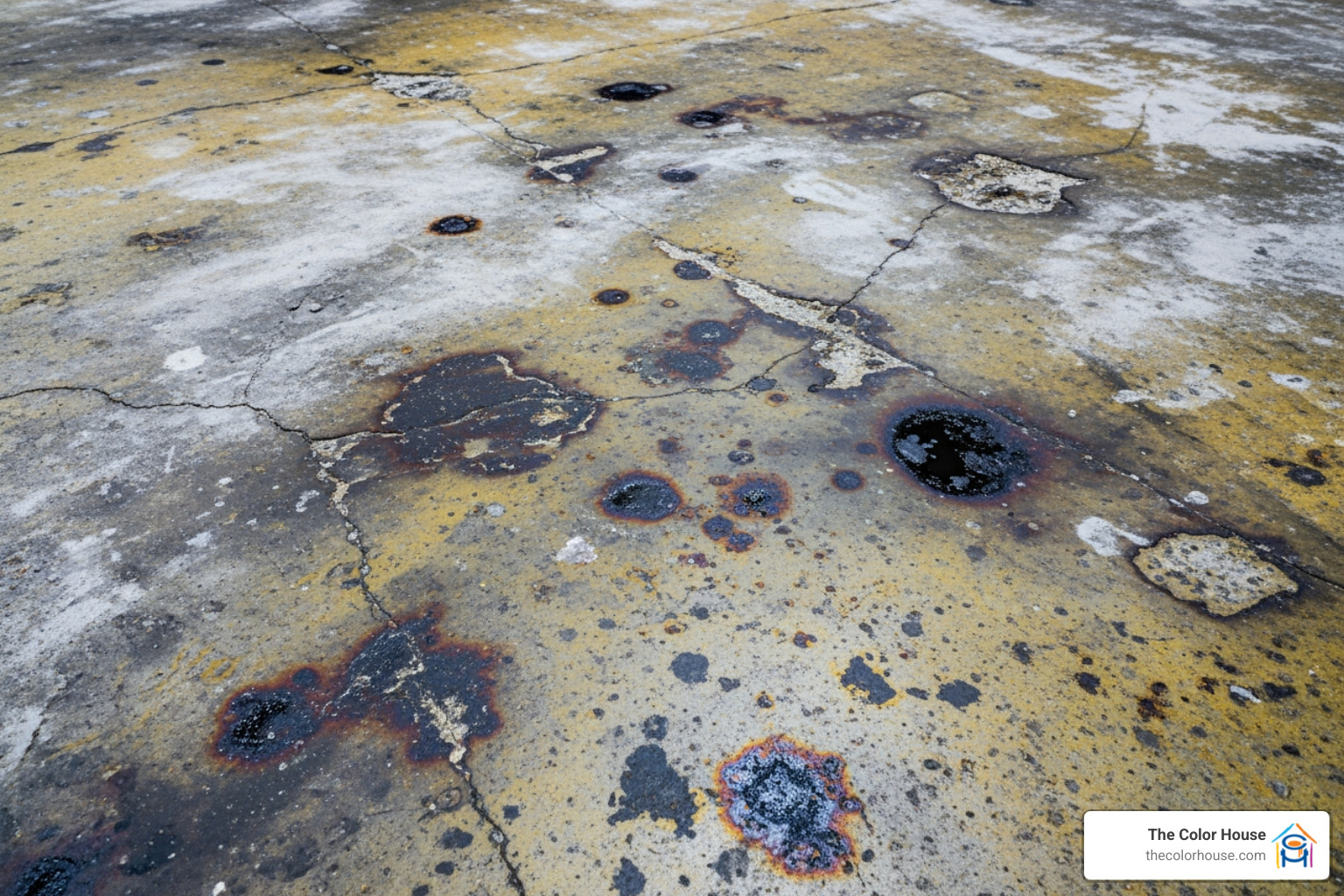
A common issue is concrete dusting. Airborne silica particles from high-traffic areas pose a serious respiratory risk to your workforce, as The porous nature of concrete allows these fine particles to be released easily.
Industrial floors also face chemical spills. An unsealed floor absorbs these substances, leading to permanent stains and concrete degradation. Heavy traffic from forklifts and machinery causes surface abrasion, creating an uneven, hazardous environment. Neglecting floor protection leads to costly repairs and downtime. Investing in high-quality industrial floor sealers is about protecting your investment, ensuring efficiency, and maintaining a safe workplace. For a broader understanding of how coatings protect industrial surfaces, explore our Industrial Coatings – A Comprehensive Guide.
Key Benefits of Sealing
Sealing your industrial concrete floors offers a multitude of benefits:
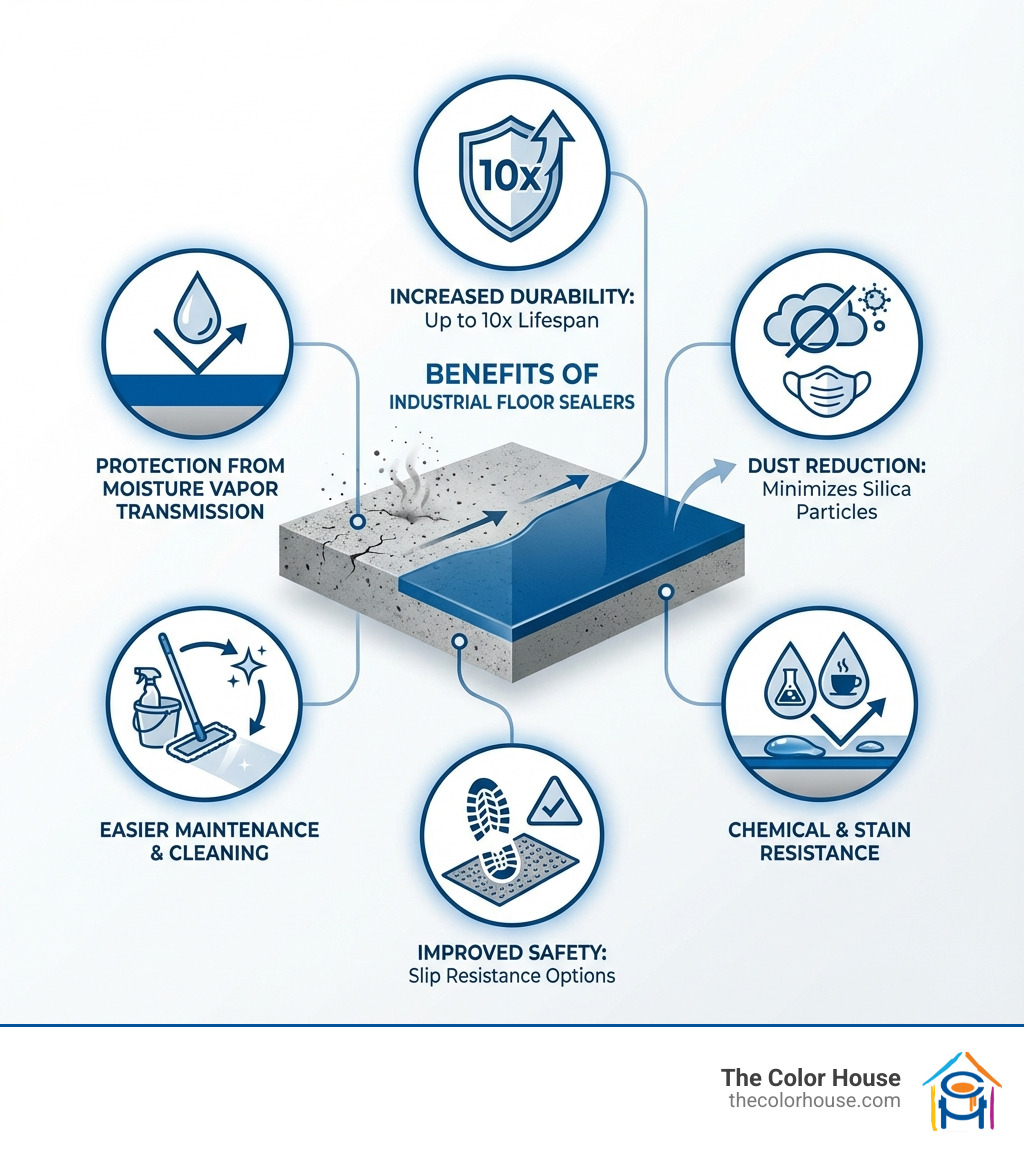
- Protection from wear and tear: A quality sealer creates a sacrificial layer that takes the brunt of daily abuse. Sealed concrete can last up to ten times longer than an unsealed surface.
- Improved durability: Sealers strengthen the concrete surface, making it more resilient to impact and heavy loads.
- Chemical resistance: Many industrial floor sealers, like epoxies and urethanes, resist a wide range of chemicals, acids, and solvents.
- Abrasion resistance: Sealers significantly reduce wear from friction in areas with heavy foot traffic, vehicle movement, or machinery.
- Stain protection: By filling pores, sealers create a non-porous barrier that prevents oils, grease, and other liquids from staining the concrete.
- Dust reduction: Penetrating sealers, especially densifiers, harden the surface and bind loose particles, drastically reducing airborne silica dust and improving air quality.
- Improved safety: Sealers can be formulated with anti-slip additives to increase traction, reducing the risk of slips and falls.
- Easier cleaning: A sealed, smooth surface is much easier to maintain, reducing labor costs and the need for harsh cleaning chemicals.
- Radon mitigation: Some sealers can diminish radon levels by creating a barrier against this radioactive gas, a known cause of lung cancer.
A Deep Dive into the Main Types of Industrial Floor Sealers
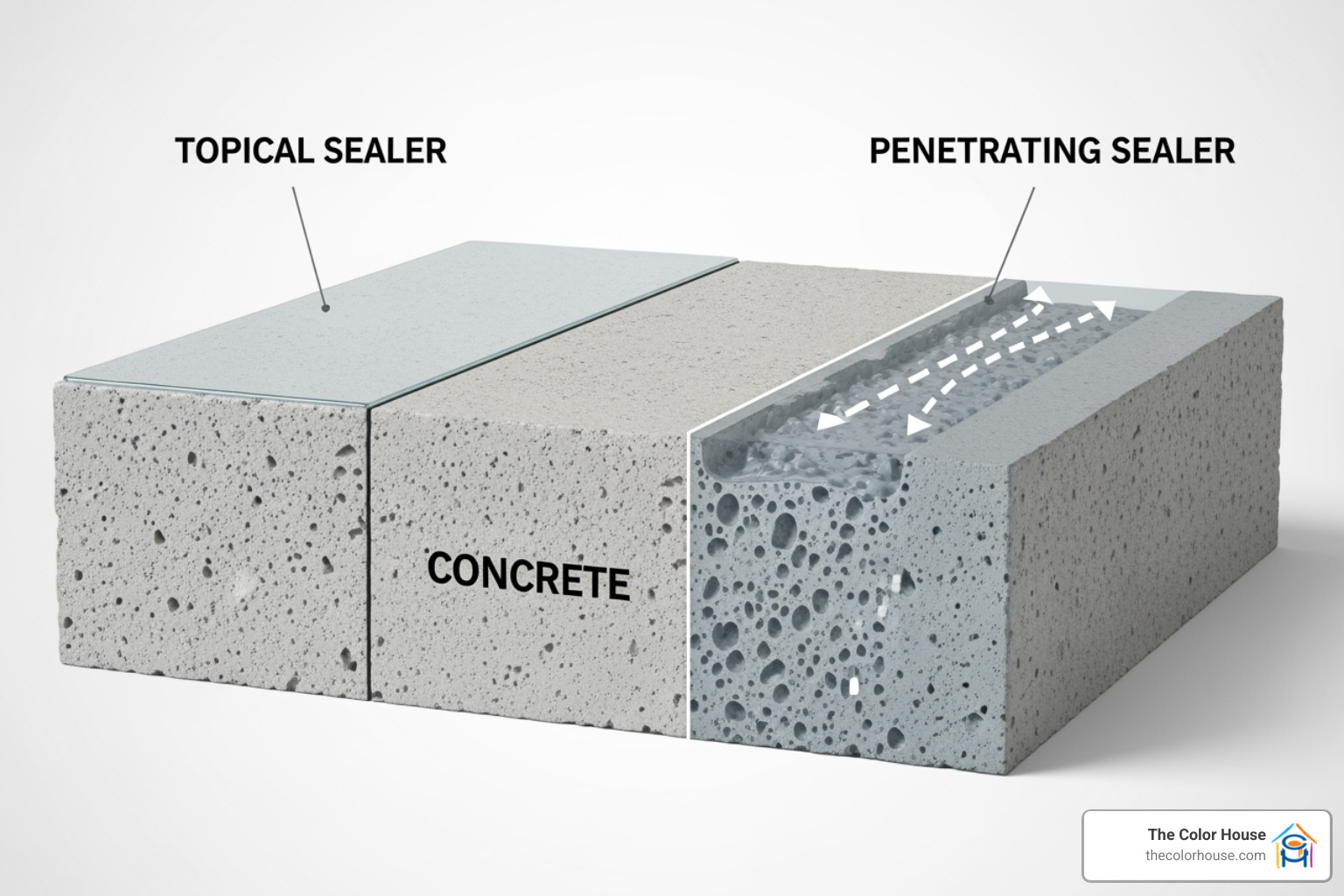
Not all sealers are created equal. They generally fall into two main types: penetrating sealers and topical coatings. Understanding their fundamental differences is crucial for making the right choice.
Penetrating Sealers (Densifiers & Repellents)
Penetrating sealers soak into the concrete’s pores and react chemically within it. They become an integral part of the concrete, offering protection from within without significantly altering the surface’s appearance or breathability.
- How they work: They absorb into the concrete and react to form a hydrophobic (water-repelling) barrier, increasing the concrete’s density and hardness.
- Natural appearance: They maintain the concrete’s natural look and texture.
- Breathability: They allow moisture vapor to escape, preventing blistering or delamination.
- Types:
- Silicates (Densifiers): These react with free lime in concrete to form calcium silicate hydrate (CSH), which gives concrete its strength. This process increases density, hardens the surface, and significantly reduces dusting.
- Silanes/Siloxanes: These are water-repellent sealers that create a hydrophobic barrier, making them excellent for exterior applications to protect against moisture and deicing salts while remaining invisible.
For options that protect your floors from the inside out, explore our Sealer Options at The Color House.
Topical Coatings (Epoxy, Urethane, Acrylic)
Topical coatings form a protective film on the concrete surface. These are the workhorses of industrial flooring, providing a robust, visible layer that acts as a barrier against spills, abrasion, and impact.
| Sealer Type | Durability | Chemical Resistance | UV Stability | Cost | Lifespan |
|---|---|---|---|---|---|
| Acrylic | Moderate, prone to wear in high traffic | Low to Moderate | Moderate (can yellow/fade) | Low | 1-3 years (needs frequent reapplication) |
| Epoxy | High, excellent abrasion and impact resistance | High (specific formulations vary) | Poor (yellows/ambers with UV exposure) | Medium to High | 5-10+ years (can be top-coated) |
| Urethane | Very High, superior abrasion resistance | Very High (excellent against many chemicals) | High (aliphatic urethanes are UV stable) | High | 10-20+ years (often used as topcoat over epoxy) |
Acrylics are cost-effective and easy to apply but have a softer finish and shorter lifespan (1-3 years). They are best for low-traffic or decorative areas.
Epoxies are robust and versatile, forming a hard, non-porous surface resistant to abrasion, impact, and many chemicals. Standard epoxies are not UV stable and will yellow, making them best for interiors.
Urethanes are high-performance coatings with superior wear resistance, durability, and chemical/UV resistance. Often used as a topcoat over epoxy, they provide exceptional abrasion resistance for high-traffic areas. Polyaspartics, a type of urethane, offer quick dry times and excellent UV resistance.
The Role of Concrete Densifiers
Concrete densifiers are a type of penetrating sealer that fundamentally improves the concrete’s properties.
- How they work: Densifiers (typically silicate-based) penetrate concrete and react with free lime to form additional CSH, which fills microscopic pores. This process significantly increases surface hardness and abrasion resistance, drastically reducing concrete dust. Densifiers are an essential step in creating polished concrete.
- Advantages: They offer permanent protection, improve durability, reduce dusting, and require minimal maintenance while allowing the concrete to breathe. Our Euclid Chemical line includes excellent densifier options.
- Disadvantages: They have limited chemical resistance compared to topical coatings and offer no aesthetic changes. They reduce liquid absorption but don’t create a complete waterproof membrane.
Matching the Sealer to the Challenge: A Selection Guide
Choosing the right industrial floor sealer requires a careful assessment of your facility’s specific environment and operational demands.
At The Color House, our expertise in Commercial Services and working with Contractors means we can help you steer these choices effectively.
Choosing the Right Industrial Floor Sealers for Your Needs
To make an informed decision, consider these critical factors:
- Heavy traffic areas: Floors with constant foot traffic, pallet jacks, or forklifts need exceptional abrasion resistance. Urethane coatings, often over an epoxy primer, are a top choice. Densifiers also help by strengthening the concrete itself.
- Forklift use: High-performance epoxy and urethane systems withstand the stress of forklifts, resisting tire marks and “hot tire pickup,” where hot tires can damage less durable sealers.
- Chemical spill zones: Facilities dealing with chemicals need sealers with superior chemical resistance. Use specific chemical-resistant epoxies and urethanes, and check the sealer’s resistance chart against the chemicals in your facility.
- Extreme temperatures: For areas like cold storage, specialized epoxies and urethanes are designed to maintain their integrity during temperature fluctuations.
- Food processing environments: These facilities require non-porous, easily cleanable epoxy and urethane coatings that resist organic acids, cleaning agents, and thermal shock from washdowns.
- UV exposure: For floors exposed to sunlight, UV stability is crucial to prevent yellowing. Aliphatic urethanes and polyaspartics are excellent choices for UV resistance, while standard epoxies will yellow.
- Moisture Vapor Transmission (MVT): Trapped moisture vapor can cause blistering under non-breathable sealers. For floors with high MVT, use breathable penetrating sealers or specialized MVT-tolerant epoxy primers.
Aesthetic and Safety Considerations
Beyond performance, consider the appearance and safety of your floor.
- Gloss vs. matte finish: High-gloss finishes can brighten a space and are easy to clean. Matte or satin finishes offer a more subdued look and can hide minor imperfections.
- Color options and tints: Topical coatings come in many colors to align with branding or demarcate zones (e.g., safety walkways). For personalized guidance, consider a Color Consultation.
- Slip resistance: Safety is paramount. While high-gloss finishes can be slick when wet, industrial floor sealers can be made slip-resistant by adding fine aggregates like aluminum oxide. This creates a textured surface that increases traction and meets safety standards.
- Light reflectivity: Glossy finishes reflect more light, which can contribute to a brighter workspace and potentially lower lighting energy costs.
From Prep to Perfection: Applying and Maintaining Your Sealer
The best industrial floor sealer won’t perform if the surface isn’t properly prepared. Neglecting this step is the most common cause of sealer failure. Proper prep involves rigorous cleaning, degreasing, and often mechanical methods like grinding or shot blasting to create a profile that the sealer can bond to.
The Application Process for Industrial Floor Sealers
While steps vary by product, a general process includes:
- Cleaning and degreasing: The floor must be free of all dirt, oil, and contaminants. This requires industrial-grade degreasers, scrubbing, and rinsing.
- Crack repair: Repair all cracks and spalls before sealing to ensure a smooth surface.
- Grinding or shot blasting: For topical coatings like epoxies, mechanical preparation like diamond grinding is essential to create a rough surface profile for a strong bond.
- Moisture testing: Before applying non-breathable coatings, test for moisture vapor transmission (MVT) to prevent delamination.
- Primer application: Some systems require a primer to improve adhesion and mitigate MVT.
- Applying the sealer: Apply the sealer with appropriate tools like squeegees, rollers, or sprayers. Two thin coats are often better than one thick one.
- Curing times: Each sealer has specific curing times. While some polyaspartics cure in under an hour, most epoxies need several days to fully cure for heavy traffic. Always follow manufacturer instructions.
Lifespan and Maintenance for Industrial Floor Sealers
The lifespan of your sealer depends on the product, traffic, and maintenance.
-
Expected lifespan by sealer type:
- Acrylics: 1-3 years, requiring frequent reapplication.
- Epoxies: 5-10+ years, longer if top-coated with urethane.
- Urethanes (including polyaspartics): 10-20+ years, especially as a topcoat.
- Penetrating sealers (densifiers, silanes/siloxanes): 10-20+ years, as they are part of the concrete.
-
Routine cleaning: Regular cleaning is essential. Daily sweeping removes abrasive debris. Periodically mop with mild, pH-neutral cleaners. Avoid harsh chemicals that can degrade the coating.
- Reapplication and repairs: Reapply topical sealers when they show significant wear. Address minor damage promptly with spot repairs to prevent larger issues.
Following the right maintenance procedures ensures your investment in The Right Industrial Coating continues to pay off for years.
Frequently Asked Questions about Industrial Sealers
Here are answers to common questions we receive from facility managers and contractors about industrial floor sealers.
How long does an industrial floor sealer last?
The lifespan varies based on the sealer type, traffic, and maintenance.
- Acrylic sealers: 1 to 3 years before reapplication is needed.
- Epoxy coatings: 5 to 10 years or more, especially when protected by a urethane topcoat.
- Urethane coatings (including polyaspartics): 10 to 20 years or longer due to their superior durability.
- Penetrating sealers (densifiers, silanes/siloxanes): 10 to 20 years or more, as they integrate into the concrete and don’t wear off.
Heavy traffic, chemical spills, and poor cleaning can all shorten a sealer’s lifespan.
Can I apply a new sealer over an old one?
It depends. Applying a new sealer over an old one requires considering compatibility and proper surface preparation.
- Compatibility is key: You cannot apply any new sealer over an existing one without checking for compatibility (e.g., water-based over solvent-based). Always check manufacturer recommendations to prevent adhesion failure.
- Surface preparation: The old sealer must be cleaned and abraded (sanded or ground) to ensure the new coat adheres properly.
- Stripping may be required: In many cases, especially if the old sealer is failing or incompatible, complete removal via chemical strippers or grinding is the best approach.
When in doubt, consult a professional to assess your floor and recommend the best course of action.
Are industrial floor sealers slippery?
Slip resistance is a critical safety concern.
- High-gloss finishes: These can be slippery, especially when wet.
- Anti-slip additives: To counteract this, anti-slip aggregates (e.g., aluminum oxide) are commonly added to topical sealers. This creates a textured surface that significantly increases traction.
- Safety standards: By incorporating anti-slip additives, sealers can be customized to meet safety requirements (e.g., OSHA), ensuring a safer workplace.
- Penetrating sealers: Because they do not form a surface film, these generally do not alter the concrete’s natural slip resistance.
When selecting a sealer, always discuss your slip resistance requirements with your supplier or applicator. We can guide you on the best options to ensure both durability and safety for your facility.
Conclusion
Choosing the right industrial floor sealer is a critical decision for your facility’s longevity, safety, and efficiency. We’ve covered why floors need sealing, the main types of sealers, and how to match a solution to your specific challenges.
Protecting your concrete reduces dust, improves safety, and simplifies maintenance. The right sealer is an investment that extends your floor’s life, minimizes downtime, and creates a safer, cleaner workplace.
At The Color House, we pride ourselves on offering personalized service, expert advice, and the largest inventory of premium coatings in Rhode Island. Our women-owned business is dedicated to providing individualized solutions that big box stores simply can’t match. We’re here to help contractors and facility managers in North Kingstown, Cranston, Wakefield, Middletown, and Smithfield, RI, make informed decisions for their industrial flooring needs.
Don’t let your industrial floor get floored by wear and tear. Contact Us today for expert guidance on selecting the perfect industrial floor sealers for your project. For a complete overview of our services, explore our Commercial and Industrial Coating Solutions.